Sunday, April 12, 2026

Fenway Park Video Shows the America We Lost

Brian Lonergan; Chronicles  

The stands at Fenway in the ’50s were full of people who had chosen America, and everything that comes with it. If we want those days back, we must choose it again unapologetically and without guilt. 

"When the Boston Red Sox’s legendary Fenway Park posted archival footage of 1950s Opening Day last week, the team expected a pleasant wave of nostalgia. But the comments section produced something else. The grainy clip showed thousands of Bostonians—men in fedoras, well-dressed women in coats, kids waving pennants—all lining up with uninhibited joy for a baseball game. After receiving almost 10 million views, the video was so flooded with pointed comments that Fenway had to lock it. The message was clear: The America in the video exposed the unmistakable decline of our current nation. Millions of viewers saw it and immediately understood why.

"The video touched a raw nerve not just because it was beautiful but because it showed how far we have fallen in what amounts to the span of a single lifetime. The decline did not happen by accident. It is largely the direct, predictable result of decades of reckless immigration policies that prioritized volume over values and social engineering over national cohesion.

"Predictably, the first instinct of critics on the left was to cry racism over these heartfelt reactions to a lost America. It is true that the crowds in the footage were overwhelmingly white. Therefore, the argument goes, any longing that scene stirs in people must be rooted in racism and xenophobia, rather than a recognition of the defects of our current cultural reality.

"This is a lazy, intellectually dishonest dodge. Race is not the point; assimilation is. The people in that 1950s footage were, in many cases, themselves first- or second-generation Americans—Irish, Italian, Polish, Jewish, among others. They were people whose parents or grandparents had arrived here through Ellis Island. They did not come to recreate the old country on American soil, transforming it. They came to become American—to transform themselves. They learned the language, embraced the civic norms, cheered on the same teams as their neighbors, and played by the same unwritten rules that made public spaces safe and orderly. Baseball was not merely entertainment. It was a sacrament of a shared American identity.

"That unifying force is precisely what is missing today. Boston Mayor Michelle Wu—who was booed loudly along with Governor Maura Healey on the field at Opening Day—recently declared that “you cannot talk about any achievement that the city of Boston has had … without talking about the Somali community that has lifted our city up.” The Fenway video is a devastating rebuttal to her. There are no Somalis visible in those 1950s stands—nor could there have been, given the timeline." . . .  More...

Brian Lonergan is director of strategic communications and content for the Federation for American Immigration Reform in Washington, D.C., and the co-host of the “No Border, No Country” podcast.

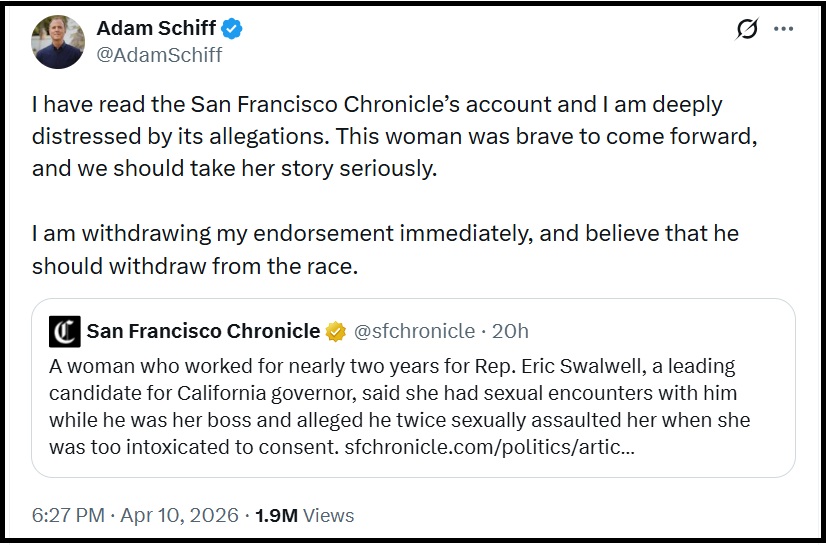
Adam Schiff Disavows His Faithful Sidekick, Eric Swalwell

 The Last Refuge  

The wheels on the bus go, whomp, whomp, whomp.


"You have to remember how close they are in all their collaborative efforts in order to truly appreciate the level of disingenuous gaslighting present in this effort to create distance.

"Throughout Spygate, Russiagate and all the impeachment nonsense, Adam Schiff was Batman to Eric Swalwell’s Robin. They were/are peas and carrots, partners in every sense of the word.

"Schiff and Swalwell organized together, planned and conducted media hits together, schemed together, shared the same staff together and were fundamentally side-by-side in everything.  However, now that Swalwell’s perverted zipper problems and rape tendencies have become the talk of California and Washington, DC, Schiff retracts:. .  . " More...


How The Algorithm Stripped The Soul Out Of Songwriting

Now maybe I can find out what an algorithm is.

The Federalist   Instead of being consumed in its entirety, a song fragment must typically succeed on social media before listeners seek out the full track.


"I'm sure you’ve experienced this ritual: a baby boomer, raised on The Beatles or Led Zeppelin, encounters a viral hit from TikTok and declares it terrible. “Today’s music,” he insists to his Gen Z interlocutor, is less melodic, less introspective, less human. Where, he asks, is the aching release of “Hey Jude,” the slow climb of “Stairway to Heaven,” the sense that a song might reveal something rather than simply repeat itself? 

"The charge is not entirely wrong. Engineering modern mainstream music often involves repeating wide-net choruses between forgettable verses, occasionally throwing in a bridge. Music from the 1960s and ’70s may have followed the same recipe, but there was something soulful about the hits of the past that cemented them as diamonds, still rediscoverable decades later. 

"What has changed is not the presence of emotional expression, but the conditions under which the feeling must be expressed. Music, like language, bends to the medium that carries it. And in the 2020s, that medium is not the radio dial, but the social media algorithm. 

"In the mid-20th century, the journey from artist to audience resembled a procession. Songs were written, recorded with real instruments, and released into a relatively stable system of promotion — labels, radio stations, critics, and live performances. Gatekeepers stood between creation and consumption, and while their power constrained access, it also created coherence. When The Rolling Stones released “Gimme Shelter” or The Doors released “Light My Fire,” those songs did not arrive as 15-second fragments but as complete statements.

"The listener, in turn, was patient. Songs could begin slowly, even experimentally, because they were not competing against the infinite scroll. One hears echoes of this in the structure of the music baby boomers grew up loving, with its extended intros and guitar solos." . . .

. . . "When a culture cannot sit still long enough to reflect on its inability to sit still and reflect, meaningful music will rarely meet the mainstream. The drumbeat of soul-catching music pounds beneath the floorboards of digital platforms, waiting for those who will pause, listen, and dig it out." . . . More...